Reviewed · TOURS IN AMMAN
Départ Garanti Francophone (GIR) DIMANCHE – SAMEDI
Petra and Wadi Rum are the stars, but this seven-day loop gives you much more: Roman Jerash, Crusader castles, Madaba mosaics, biblical Mount Nebo, and a float in the Dead Sea. The route packs in Jordan’s major sights without asking you to arrange hotels, drivers, meals, or entry tickets yourself.
I like the permanent French-speaking guide, which makes the long drives and ancient sites easier to understand, and I like the mix of famous stops and quieter places such as Little Petra. The main drawback is the pace. You cover a lot of ground in six touring days, and some stops may feel brief, especially if you prefer slow museum visits or long walks.
Key points to know before booking
- Petra gets a full touring day, with lunch and time to explore its major monuments.
- Wadi Rum includes a 90-minute local Bedouin 4×4 ride and an overnight stay in Bedouin tents.
- Jerash and Ajloun make a strong northern Jordan day, with Roman ruins and a mountain fortress.
- Five lunches, five dinners, and six breakfasts are included, but drinks and gratuities are extra.
- A French-speaking guide stays with the group during sightseeing days, useful for history, directions, and local context.
- The advertised route needs checking, since Shobak appears in the overview but is not given a clear stop in the daily schedule.
A seven-day route that covers Jordan’s big sights
At $1,335 per person, this is a packaged Jordan circuit built around convenience. You get airport transfers, a modern air-conditioned vehicle sized for the group, entry fees listed in the program, meals, a French-speaking guide, and the desert 4×4 excursion.
That price can make sense if you want one booking to handle the moving parts. Jordan’s highlights are spread across the country, and arranging a driver, hotels, local meals, and tickets separately takes time. The value is less clear if you want a private trip, a very small group, or full control over each stop.
The maximum group size is listed as 150 people, though the actual vehicle will depend on the number booked. Ask about the expected group size before paying if personal attention matters to you. The experience is described as a guaranteed French-speaking departure running Sunday to Saturday, a useful feature for solo visitors or couples who do not want to gather their own group.
Other trips people book in Amman:
- Amman: Petra, Wadi Rum, and Dead Sea 2-Day Tour
★ 4.9 · 1,173 reviews - 2-Day Tour: Petra, Wadi Rum, and Dead Sea from Amman
★ 5.0 · 1,141 reviews - From Amman: Petra & Wadi Rum Private or group Day Tour
★ 4.9 · 750 reviews
Day one: an easy arrival in Amman
Your trip begins with pickup at Queen Alia International Airport and a transfer to your Amman hotel. The listed start time is 8 a.m., so confirm how the operator handles a flight arriving later in the day.
The first day is intentionally light. You have dinner and sleep in Amman rather than rushing into sightseeing after a flight. That is sensible, although the schedule does not include a formal Amman city tour on this day.
Some past guests traveled with drivers and guides named Audi, Jacob, Haithem, and Ahed. These names come from different departures, so you should not assume one of them will lead your group. Still, the pattern is useful: a friendly, careful driver can make a real difference on Jordan’s long road days, especially for families.
Day two: Roman Jerash and Ajloun Castle
Jerash sits about 45 kilometers from Amman and is one of Jordan’s finest ancient sites. Its broad colonnaded streets, temples, plazas, and theaters show the order of a Roman provincial city. Pale pink and orange limestone gives the ruins a warm look in the early and late sun.
You have about three hours at the ruins, with admission included. That is enough to see the main areas, but Jerash rewards an unhurried pace. Wear shoes with a firm sole, since ancient paving can be uneven, and bring water even though one bottle is supplied on the bus during sightseeing.
The Roman remains are not just a collection of broken stones. You can read the city plan through the long colonnaded avenue and open public spaces. A French-speaking guide is particularly helpful here, because the scale of Jerash makes it easy to miss how the buildings worked together.
After lunch, the route continues to Ajloun Castle, also called Qalaat ar-Rabad. Built in the 12th century during the time of Saladin, the fortress helped protect the region, control local iron mines, and watch routes toward Jerusalem.
Ajloun is a good counterpoint to Jerash. Jerash spreads across open ground, while the castle sits high on a mountain. From the top, you get broad views toward the Jordan Valley. The castle involves stairs and uneven floors, so the moderate fitness requirement matters here.
You return to Amman for dinner and another hotel night. It is a full day, but the pairing works well: one major Roman site, one medieval fortress, and no need to change hotels.
Day three: mosaics, Mount Nebo, and Kerak
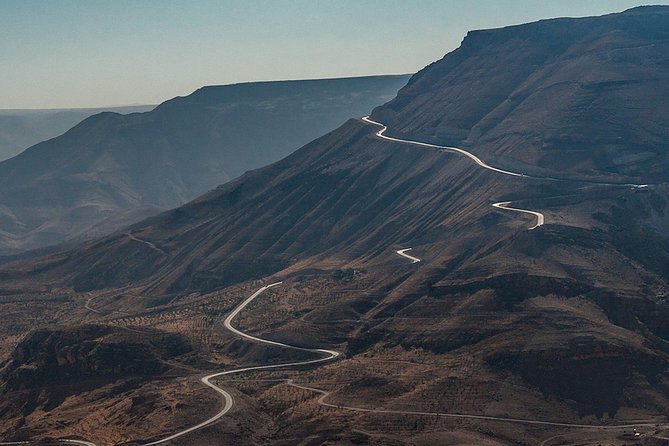
Day three follows the historic King’s Highway toward southern Jordan. The first major stop is Madaba, known for its Byzantine mosaics.
At St. George’s Church, you see the famous sixth-century mosaic map of the region. It once measured about 25 meters by 5 meters and used roughly two million tesserae. Much of it has been damaged, but enough remains to show towns, routes, and the geography known to its makers.
This is a relatively compact visit, listed at about two hours. The church is a meaningful stop for anyone interested in early Christian art, and the guide can help you make sense of a floor map that is not always easy to read at a glance.
From Madaba, you continue to Mount Nebo, about 10 kilometers away. The summit reaches roughly 840 meters and is traditionally linked with the place where Moses saw the Promised Land before his death. The biblical setting gives the stop its emotional force, while the elevated position provides wide views across the surrounding country when conditions are clear.
The scheduled visit lasts about an hour. Do not expect a long mountain walk. This is primarily a viewpoint and religious site, with time for the church area and mosaics.
The day continues to Kerak Castle. The fortress was built in 1142 by the Crusader lord Payen le Bouteiller and later became associated with Reynald of Châtillon. Its position above the Wadi Kerak made it a major defensive point along routes toward Palestine.
Kerak is atmospheric but rough underfoot. Corridors, stairs, and dark chambers reward curiosity, yet the visit is not ideal for anyone who struggles with uneven surfaces. The two-hour stop gives you time to explore, though the castle’s size and history can make a guide’s explanations especially useful.
The route description also names Shobak among the places covered by the tour, but the daily schedule does not give Shobak Castle a separate stop. Ask the operator to confirm if it is included on your departure. This is one of the most important details to clarify before booking.
Same base, a different sort of day out:
- From Amman: Petra and Wadi rum Full day Tour
★ 5.0 · 538 reviews - 2-Day Petra, Wadi Rum and Dead Sea Tour from Amman
★ 5.0 · 467 reviews - 3-Day Private Tour from Amman: Petra, Wadi Rum, Dana, Aqaba, and Dead Sea
★ 5.0 · 425 reviews - Petra Full-Day Private Tour from Amman
★ 4.9 · 392 reviews
Day four: giving Petra the time it deserves
Petra receives a full day, listed at about six hours. That is the right amount of time for a first visit, though Petra is large and your walking total will depend on how far you go beyond the main monuments.
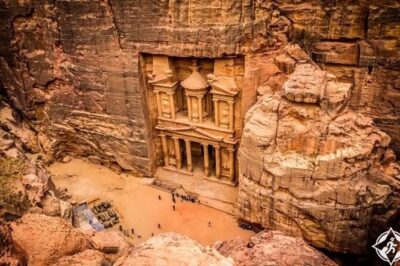
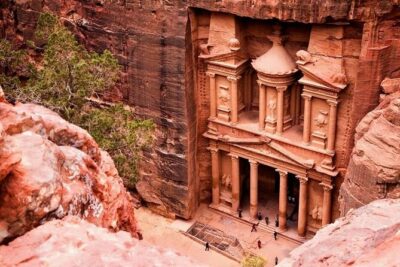
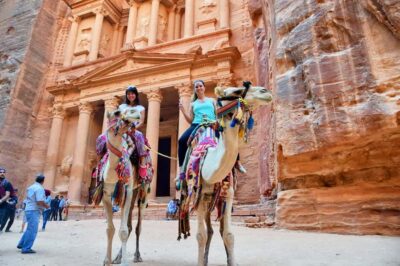
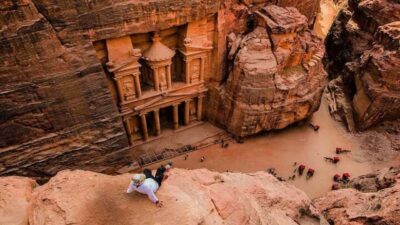
You enter the famous Nabataean city through the Siq, a narrow rock corridor that leads to the Treasury. The route then opens toward Petra’s main valley, where you can see carved facades and ancient remains. The program leaves room for morning exploration, a local lunch, and more sightseeing in the afternoon.
A full day is one of this tour’s strongest features. Short Petra visits can feel like a hurried photo stop. Here, you have a better chance to appreciate the change from narrow canyon to open valley and to spend time looking at the carved stone rather than simply passing through.
The optional horse-drawn carriage is not included. If you are considering it, ask about the extra cost and exactly which part of the route it covers. The tour requires moderate fitness, and Petra’s uneven ground, slopes, and extended walking can be tiring.
Bring sun protection, water, and comfortable shoes. A bottle of water is supplied on the bus during visits, but you should not rely on that alone for a long day outdoors. Lunch and dinner are included, though drinks are not.
Day five: Little Petra and a night in Wadi Rum
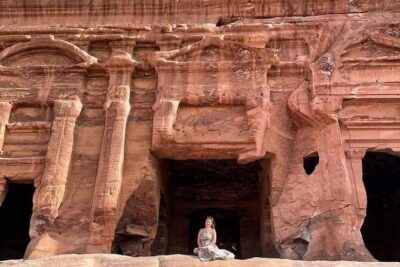
The morning begins at Al-Beidha, better known as Little Petra. It is smaller and quieter than the main Petra site, with rock-cut passages and facades in a compact setting. The visit lasts about an hour, making it a pleasant introduction before the open desert.
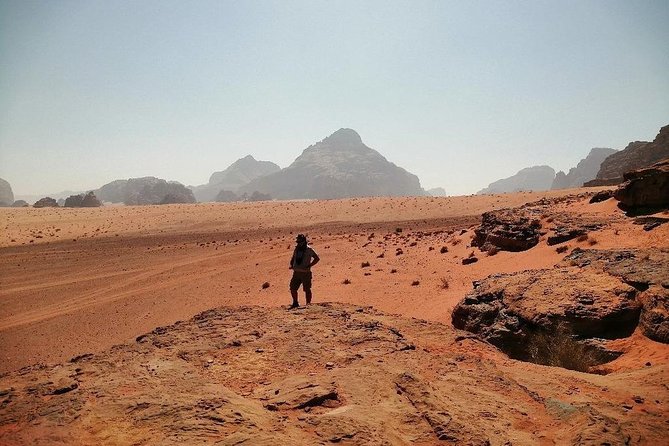
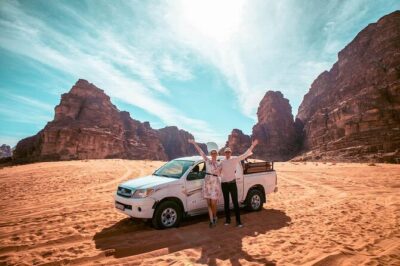
You then travel to Wadi Rum, a huge desert of sandstone cliffs, peaks, and valleys. The setting became widely known through the story of T. E. Lawrence and its connection with the Arab Revolt, but you do not need that background to appreciate the silence and scale.
The included local Bedouin 4×4 excursion lasts about 90 minutes. This is an important detail: you are not simply driving past the desert on the way to the Dead Sea. You get a dedicated ride into Wadi Rum, followed by lunch at a Bedouin camp.
The trip ends with dinner and a night in Bedouin tents. Camp conditions can vary, so ask what type of tent and bathroom setup applies to your departure if comfort is a priority. The overnight stay gives you more time in the desert than a quick afternoon transfer would, but it also means leaving city-style accommodation behind for one night.
The contrast with Petra is the point. Petra shows what people carved into stone. Wadi Rum shows what wind, rock, and open space can do without human construction.
Day six: from Wadi Araba to the Dead Sea
After breakfast at camp, you travel along the Wadi Araba route toward the Dead Sea. This is another long transfer day, but the change in scenery is part of the experience.
The Dead Sea lies about 1,306 feet below sea level and is bordered by mountains to the east and the hills around Jerusalem to the west. You have lunch and free time for swimming.
Floating here is unlike ordinary swimming. The mineral-heavy water makes it easy to stay on the surface, but you should avoid splashing water into your eyes and cover any cuts. The provided information describes the area’s long-standing reputation for therapeutic benefits, but you should treat the experience as recreation rather than medical care.
The two-hour stop is enough for a taste of the Dead Sea, not a full spa day. If you want a longer resort stay, this tour may feel too brief. For a first visit, though, it gives you the unusual floating experience before returning to Amman for departure.
Meals, transport, and what the price really covers
The package includes six breakfasts, five lunches, and five dinners. That removes much of the daily guesswork, especially on remote portions of the route. Lunches are particularly useful around Petra, Wadi Rum, and the long southern drives, where independent restaurant choices may be limited.
Drinks are not included. Keep cash available for beverages, small purchases, and tips for guides, drivers, restaurants, and hotel staff. Tips are customary and specifically excluded from the tour price.
Transport is provided in modern, air-conditioned vehicles according to group size. That matters in Jordan, where the route includes long road sections between northern ruins, Petra, Wadi Rum, and the Dead Sea.
Accommodation is used in Amman, Petra, and the desert camp, but the inclusion list does not spell out the hotel category or room details. Ask for the hotel names, room arrangement, and what happens if you need a single room. A single supplement applies when an extra room is required.
The recommended Jordan Pass may also affect your final cost. It can include visa entry fees and access to 41 sites, so check the official Jordan Pass site before arrival and compare its benefits with the entry fees already included in this package.
Who will enjoy this Jordan tour most?
I would choose this trip if you want the main sights organized in one loop and prefer a French-speaking guide throughout the sightseeing days. It suits first-time visitors, couples, families, and solo travelers who value a set route and included meals.
Families should note the positive experience described by a parent who felt especially safe with driver Jacob while traveling with a young child. That does not guarantee a particular driver, but it points to the importance of communicating any family needs before arrival.
I would hesitate if you want long stays in each place, independent restaurant hunting, or a private guide. A maximum of 150 participants is listed, and even if the group is divided among vehicles, the experience is built for efficient sightseeing rather than a custom schedule.
The tour also requires moderate physical fitness. Petra, Ajloun, Kerak, and Wadi Rum all involve uneven ground, stairs, walking, or outdoor exposure.
Should you book it?
Book this tour if you want Petra, Wadi Rum, Jerash, Madaba, Mount Nebo, Kerak, and the Dead Sea in one organized week, with French-language support and most major costs handled upfront. The full Petra day and overnight Wadi Rum stay give the trip more substance than a simple highlights drive.
Before booking, confirm three things: the exact hotels, the expected group size, and whether Shobak is truly included. If those details suit you, $1,335 is a reasonable convenience-focused price for a seven-day Jordan circuit. Free cancellation is available up to 24 hours before the start time, but changes or cancellations inside that window are not refundable.
FAQ
Where does the tour begin?
The tour begins with pickup at Queen Alia International Airport in Amman, Jordan. The listed start time is 8 a.m.
How long does the tour last?
The experience lasts approximately seven days, running from Sunday to Saturday.
Is a French-speaking guide included?
Yes. A permanent French-speaking guide is included during the sightseeing days.
Which major sites are included?
The scheduled route includes Amman airport transfers, Jerash, Ajloun Castle, Madaba, St. George’s Church, Mount Nebo, Kerak Castle, Petra, Little Petra, Wadi Rum, and the Dead Sea.
Is the Wadi Rum 4×4 ride included?
Yes. A local Bedouin 4×4 excursion lasting about one and a half hours is included.
Are meals included?
The package includes six breakfasts, five lunches, and five dinners. Drinks are not included.
Are flights and tips included?
No. Airfare, customary tips for guides, drivers, restaurants, and hotels, travel insurance, drinks not listed in the program, and the optional Petra carriage ride are excluded.
Can I cancel for a full refund?
Yes, if you cancel at least 24 hours before the experience start time. Cancellations or changes made less than 24 hours before the start time are not accepted for a refund.
Just added in Amman
- 2-Day Private Tour in Jordan – Deluxe Tent★ 5.0 · 9 reviews
- Queen Alia Airport Transfers From / To Amman, Petra, Dead Sea.★ 5.0 · 3 reviews
- FROM AMMAN | Petra & Wadi Rum in one day | The Jordanian Mappers★ 5.0 · 12 reviews
- From Amman :Private full day tour to Jerash ,Ajoune and Um Qais★ 5.0 · 12 reviews
- From Amman to West ( Madaba, Mt Nebo, baptism site and dead sea)★ 4.0 · 5 reviews
- Dead Sea Half-Day Tour from Amman★ 5.0 · 8 reviews
- airport pick up & transportations Services★ 5.0 · 15 reviews
- NEOM Saudi Arabia Transfer from AMM Airport or Aqaba Airport AQJ★ 5.0 · 3 reviews
Tours in Amman, compared.
3-Day Private Tour from Amman: Petra, Wadi Rum, Dana, Aqaba, and Dead Sea
Read our review →