
Reviewed · TOURS IN AMMAN
Multi day tour in Jordan – 08 Days
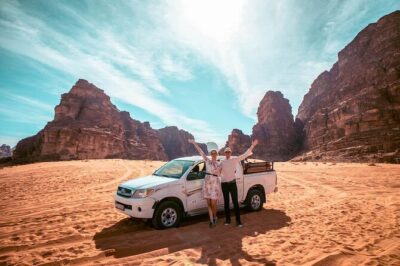
Petra is the star, but Wadi Rum after dark may be the tour’s most memorable surprise. You walk through Petra’s narrow Siq with a guide, then trade carved stone for red desert, a three-hour Jeep ride, and a Bedouin barbecue beneath a wide night sky.
I like the private format, which gives you your own vehicle and English-speaking driver rather than a fixed coach schedule. I also like the smart route: Jerash and Ajlun early, Petra in the middle, then Wadi Rum and Aqaba before returning north.
The main drawback is pace. You cover much of Jordan in seven nights, with several long drives and only one full day in Petra. The Dead Sea stop is relaxing, but the free day in Aqaba and the final drive back to Amman can feel less focused than the major sightseeing days.
Key points to know before booking
- Petra gets a full guided day: You enter through the Siq, see the Treasury, and continue among tombs, temples, and other Nabataean remains.
- Wadi Rum includes a three-hour Jeep trip: A local Bedouin guide drives, followed by a simple camp stay and included barbecue dinner.
- Your driver is part of the experience: Drivers such as Mohammed, Ahmad, Hisham, Yasser, and Aladdin have been praised for punctuality, care, local food suggestions, and practical help.
- The route covers Jordan’s major sights: Jerash, Ajlun, the Baptism Site, the Dead Sea, Petra, Little Petra, Wadi Rum, Aqaba, Kerak, Madaba, and Mount Nebo.
- You can match lodging to your budget: Both budget and 4-star packages include breakfast.
- The price covers more than transportation: At $1,764.11 per person, the package includes seven nights, entrance fees, guides, transfers, breakfast, a Dead Sea resort lunch, and a Wadi Rum camp dinner.
What this eight-day Jordan route does well
This is a highlights tour for someone who wants Jordan arranged in a logical loop. You land at Queen Alia International Airport, travel north and west before heading south to Petra, then continue to Wadi Rum and Aqaba before returning to Amman.
That route saves you from arranging separate taxis, hotels, guides, and admission tickets. You get one private vehicle for the trip, an English-speaking driver, and meet-and-assist service at the airport. The vehicle is described as brand new, and past arrangements have included spacious air-conditioned vans with Wi-Fi.
Your driver is not the same as a fully licensed guide at every stop. You receive a dedicated English-speaking guide for about three hours in Petra and about ninety minutes in Jerash. At Wadi Rum, your local Bedouin guide also serves as the Jeep driver.
That distinction matters. Petra and Jerash benefit from a proper site explanation, while your main driver handles the roads, timing, hotel transfers, and daily coordination. Several drivers associated with the company, including Mohammed, Ahmad, Hisham, Yasser, Aladdin, and Hussam, have been singled out for punctuality, kindness, and help with local meals and small arrangements.
Other trips people book in Amman:
- Amman: Petra, Wadi Rum, and Dead Sea 2-Day Tour
★ 4.9 · 1,173 reviews - 2-Day Tour: Petra, Wadi Rum, and Dead Sea from Amman
★ 5.0 · 1,141 reviews - From Amman: Petra & Wadi Rum Private or group Day Tour
★ 4.9 · 750 reviews
Amman arrival and a gentle first evening
Your trip begins at Queen Alia International Airport. After immigration and customs, a representative meets you and escorts you to your Amman hotel.
No sightseeing or meals are included on the first day. That is useful if your flight arrives late, since you are not paying for a rushed evening program. If you land early, you can use the spare time for an optional Amman outing, but the supplied plan does not specify an included activity.
You spend three nights in Amman in total, though the first night is mainly for arrival and rest. Amman is spread across hills, so your hotel location and the day’s traffic can affect how much energy you have for extra exploring. This tour does not try to fill every hour, which gives you some breathing room after the flight.
Ajlun Castle and Jerash on day two
The second day heads north to Ajlun Castle, a hilltop fortress built in 1184 by one of Saladin’s generals. Its purpose was military: it protected iron mines, watched important routes, and helped control movement through the Jordan Valley.
The castle is compact but atmospheric. You climb through stone rooms and defensive spaces, then look across the surrounding hills from its elevated position. On a clear day, the view may reach toward the Dead Sea.
Allow about two hours here. The attraction is as much about the setting as the rooms themselves, so wear shoes that feel secure on uneven stone. The site is uphill, and the visit is not simply a flat walk from one display to another.
After Ajlun, you continue to Jerash for roughly three hours. This is one of Jordan’s strongest Roman-era sites, with colonnaded streets, temples, theaters, public squares, baths, fountains, gates, and city walls.
Jerash rewards a guide because its scale can be hard to understand at first. A guide points out how the streets, theaters, and religious buildings fit together instead of leaving you with a field of impressive but disconnected ruins. The included guided portion is about ninety minutes, followed by time to look around.
This is a full sightseeing day. Ajlun and Jerash are not next door to Amman, and the combination includes walking, hills, stone surfaces, and open sun. Still, it is an excellent opening because you see two very different sides of northern Jordan: a medieval Islamic fortress and a formal Roman city.
The Baptism Site and the Dead Sea
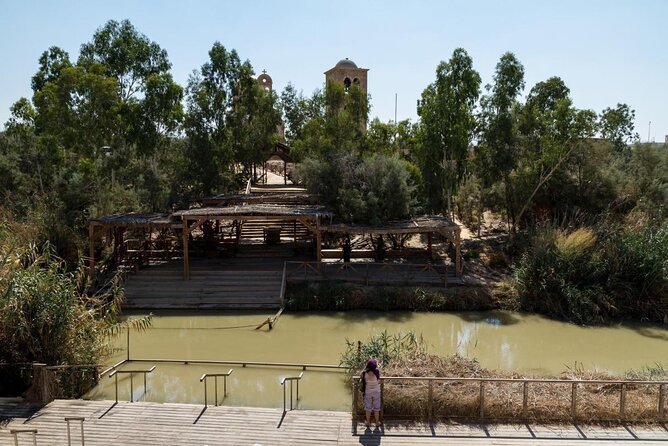
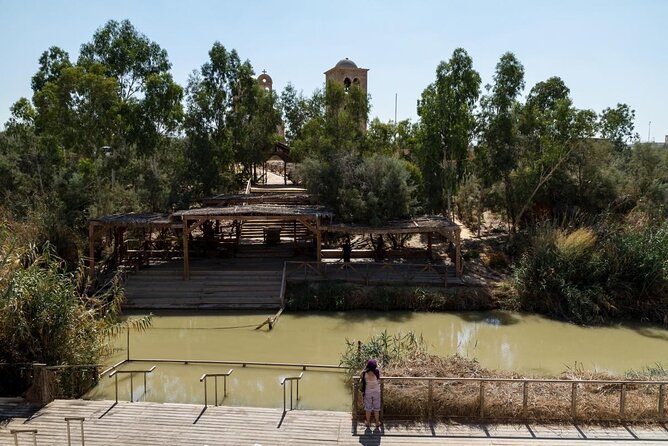
After breakfast on day three, you leave Amman and drive toward the Jordan Valley. Your first stop is the Baptism Site of Jesus Christ, traditionally identified with the place where John the Baptist baptized Jesus.
The visit takes about two hours and includes admission. The site has religious importance for several Christian traditions, but you do not need to approach it only as a faith visit. It is also a quiet historical stop in a striking part of the Jordan Valley, with churches, baptism-related areas, and a sense of distance from the capital.
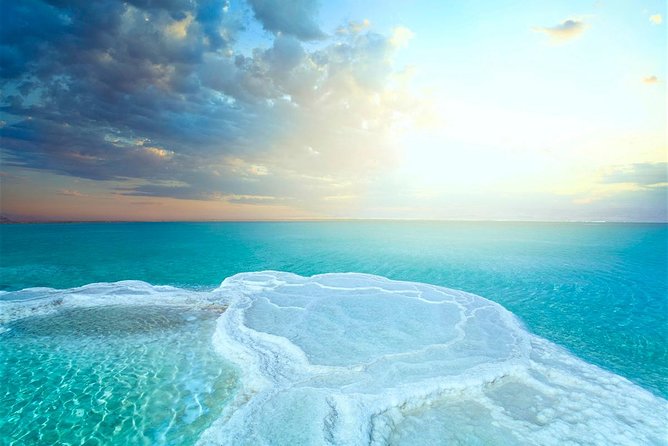
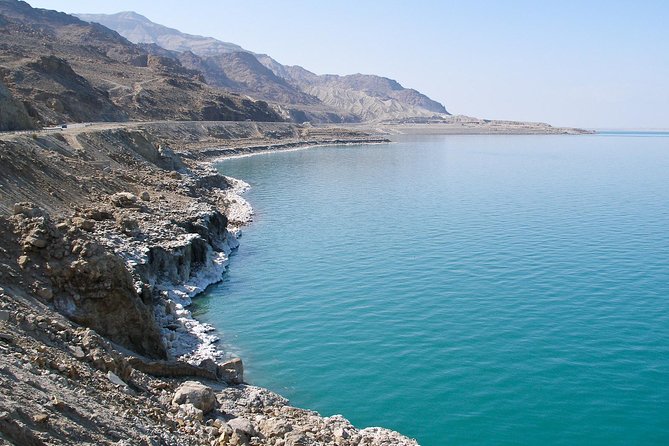
Afterward, you continue to the Dead Sea for a half-day beach stop. The shore lies about 422 meters below sea level, making this the lowest point on dry land. Its heavy salt content lets you float easily, though you should keep the water away from your eyes and avoid entering with cuts.
The admission includes access to a beach resort and lunch. You can float, sit by the water, and use Dead Sea mud as part of the stop. This is a welcome change after the previous day’s ruins and walking.
Do not expect a wilderness beach. The visit is organized around a resort, and the value is comfort and convenience rather than solitude. Bring a swimsuit, sandals, sun protection, and a change of clothes. You should also allow time to rinse the salt from your skin before the drive south.
The journey continues to Wadi Musa, the town beside Petra. You stay there for two nights, making it possible to see Petra without packing and unpacking each morning.
Same base, a different sort of day out:
- From Amman: Petra and Wadi rum Full day Tour
★ 5.0 · 538 reviews - 2-Day Petra, Wadi Rum and Dead Sea Tour from Amman
★ 5.0 · 467 reviews - 3-Day Private Tour from Amman: Petra, Wadi Rum, Dana, Aqaba, and Dead Sea
★ 5.0 · 425 reviews - Petra Full-Day Private Tour from Amman
★ 4.9 · 392 reviews
Petra deserves the full eight-hour day
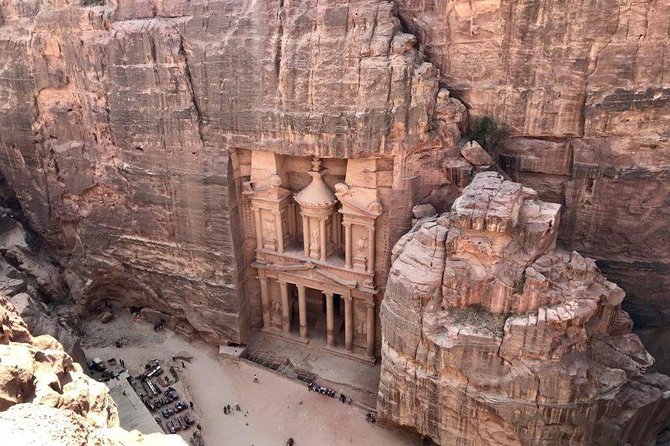
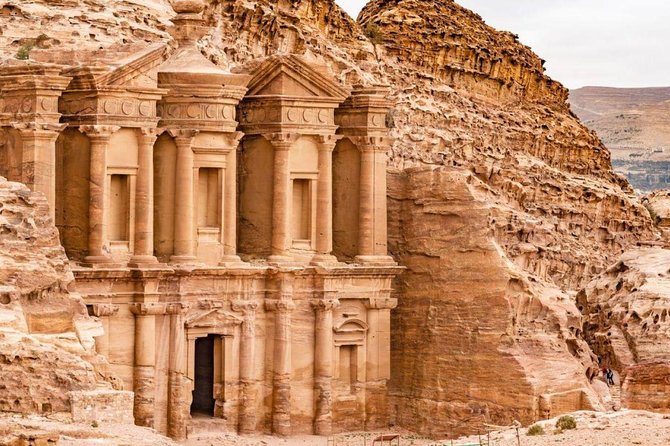
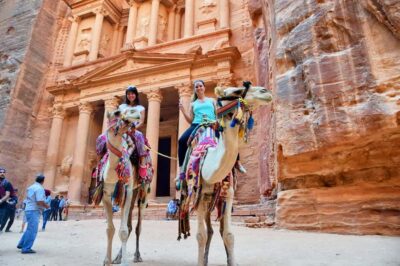
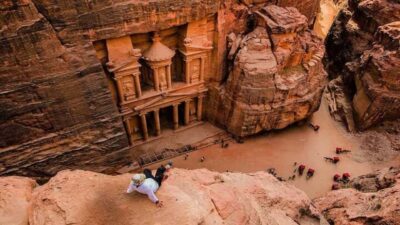
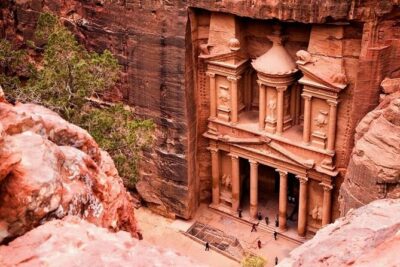
Petra is the centerpiece of the route, and the schedule gives it the time it needs. After breakfast, your Petra guide leads you through the Siq, a long, narrow passage between sandstone walls.
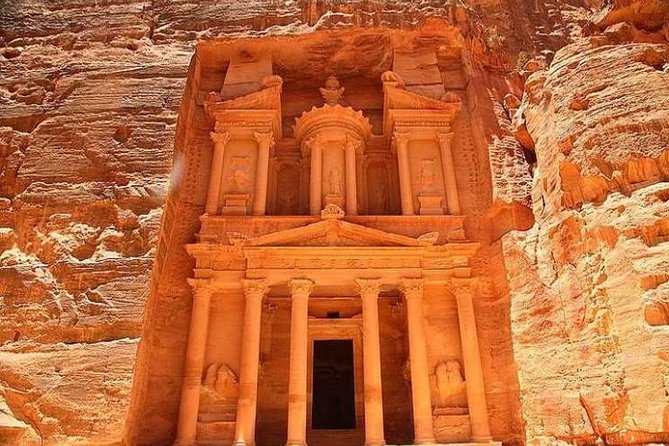
The first view of the Treasury comes at the end of that passage, and it is one of Jordan’s great travel moments. The building is not a freestanding palace waiting inside the canyon. It is cut directly into the rock, which makes the transition from the shadowed Siq to the open facade especially effective.
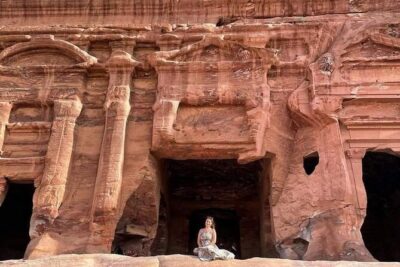
The Treasury is only the beginning. You continue past rock-cut tombs, temples, storerooms, and other remains of the Nabataean city. Petra was a trading center shaped by the Nabataeans, who built an urban system in a difficult, dry setting.
The guided portion lasts about three hours, while the full Petra visit is listed at about eight hours. That gives you time to continue at your own pace after the guide finishes. You should not treat this as a quick photo stop. Petra is extensive, and the ground is uneven. Comfortable walking shoes are essential.
The best approach is to conserve energy early. The Siq and Treasury are easy to focus on because they are the first major sights, but Petra keeps going. If your guide explains the layout first, you can make better choices about how far you want to walk and which monuments matter most to you.
Petra can also be physically demanding in heat. The tour does not list a special accessibility program, and most travelers can participate, but the long walking distance and stone paths deserve honest consideration. If you prefer a slower visit, use the private driver’s flexibility to discuss timing in advance.
Little Petra and a night in Wadi Rum
Day five begins with a short drive to Al Beidha, better known as Little Petra. It is smaller than Petra but worth the hour-long stop because it helps you see how Nabataean spaces extended beyond the main city.
Buildings, storage areas, tombs, water channels, and cisterns were cut into lighter sandstone. The narrow site feels more enclosed than Petra, and the shorter visit gives you a useful contrast without taking away from the main attraction.
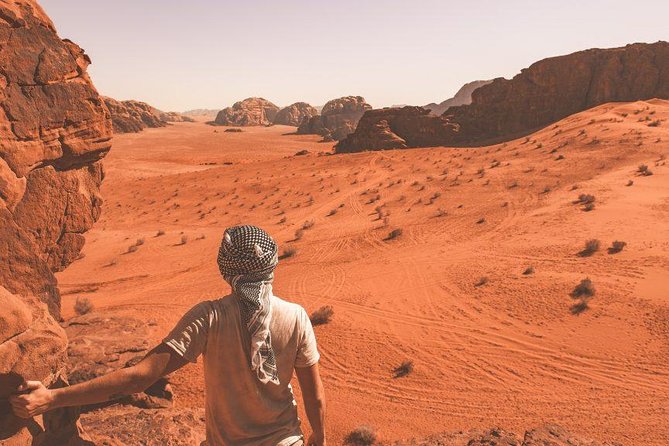
Next comes Wadi Rum, where the scenery changes sharply. This is a broad desert region associated with T.E. Lawrence and the Arab Revolt against the Ottoman Empire during World War I. Bedouin communities remain closely connected to the area.
Your included Jeep trip lasts about three hours and uses a local Bedouin guide as driver. That local connection matters because Wadi Rum is not simply a road trip through sand. The experience depends on moving between rock formations, open desert, and places that carry cultural and historical meaning.
The overnight camp is simple. Mattresses and blankets are provided, and toilet facilities are available, but this is not a conventional hotel. You can sleep in a goat-hair tent or, conditions permitting, under the stars. A barbecue dinner is included.
That simplicity is part of the appeal, but you should pack for it. A warm layer can help at night, and a small overnight bag is easier than carrying your full luggage around camp. Keep expectations realistic: the Wadi Rum night is about desert atmosphere, local hospitality, and the sky, not polished resort service.
Aqaba gives the route a change of rhythm
After breakfast, you drive to Aqaba, Jordan’s port on the Red Sea. The rest of the day is free, and you stay one night.
Aqaba is a useful pause after Petra and Wadi Rum. You can spend time at the beach, look for snorkeling opportunities, eat at local restaurants and cafés, or shop for souvenirs in the free-zone area. The plan gives you flexibility rather than assigning another long list of sights.
The trade-off is that the free day is not a structured beach excursion with listed equipment or a named snorkeling guide. You arrange your own time after hotel check-in, so ask your driver or tour contact for practical suggestions if you want a more active day.
I like this pause because the route has already packed in major archaeological sites. Some people, though, may wish the day included a more defined Red Sea activity. If Aqaba is a key reason for booking, clarify exactly what beach access and hotel facilities come with your chosen accommodation package.
Kerak, Madaba, and Mount Nebo on the way back
Day seven is the longest-feeling transition day. You leave Aqaba and head north toward Amman, stopping at Kerak Castle, Madaba, and Mount Nebo.
Kerak Castle was built under King Fulk of Jerusalem and later taken by Saladin’s forces. The fortress rises above the town and is best understood as a defensive stronghold rather than a finely decorated palace. Dark corridors, thick stone walls, and elevated views give the visit a strong sense of medieval military life.
The castle stop lasts about an hour. That is enough for a focused visit, though you will not examine every corner at leisure.
Madaba follows, with about an hour in town. Its most famous work is the sixth-century mosaic map of Jerusalem and the Holy Land in St. George’s Church. Madaba also has other Byzantine mosaics showing plants, animals, fish, hunting, farming, and daily life.
This is a small-scale art stop after the huge spaces of Petra and Jerash. Look closely rather than expecting a grand building. The mosaics reward patience and attention to detail.
Mount Nebo completes the sightseeing. The summit is linked to the biblical account of Moses looking toward the Promised Land, and a church there contains preserved mosaics. The main attraction is the view across the Jordan Valley, with scenery that connects the religious story to the geography around you.
The visit lasts about an hour and includes admission. After these stops, you return to Amman for the final night.
What the $1,764.11 price includes
At $1,764.11 per person, this is not a low-cost independent trip, but the comparison should not be made against hotel-only prices. The package includes airport assistance, private transfers in a new vehicle, an English-speaking driver, seven breakfasts, seven nights of accommodation, entrance fees for listed sites, a three-hour Petra guide, a ninety-minute Jerash guide, the Wadi Rum Jeep ride, the camp, the camp dinner, and access to a Dead Sea beach resort with lunch.
Jordan visa fees are also included when the required passport details are supplied in advance. That can remove a useful arrival-day chore.
You still pay for tips, travel insurance, personal expenses, and meals not specifically listed. Dinner is included at the Wadi Rum camp, but the other dinners are not. Lunch is included at the Dead Sea resort, while other lunches are generally your responsibility.
The choice between budget and 4-star lodging is important. If you care most about spending time at Petra, Wadi Rum, and the Dead Sea, the budget option may offer better overall value. If comfortable hotels and easier evenings matter more, the 4-star package may be worth the extra cost.
Who should book this Jordan tour?
You should consider it if you want the major Jordan sights without planning every transfer yourself. It suits first-time visitors, families, couples, and small private groups that prefer a dedicated vehicle over a large coach.
It is also a strong choice if you want both archaeology and scenery. Jerash, Petra, Little Petra, Kerak, Madaba, and Mount Nebo cover different periods and traditions, while the Dead Sea, Wadi Rum, and Aqaba break up the stone sites.
I would hesitate if you dislike long drives, simple camping, or tightly packed sightseeing days. You may also prefer a slower trip with two full days at Petra and more time in Amman or Aqaba.
The company allows a full refund when you cancel at least six full days before the start time. A cancellation two to six days ahead may receive 50 percent, while cancellations less than two days before departure are not refunded. The operator can also change the date or provide a full refund if poor weather or an insufficient minimum number of participants cancels the experience.
FAQ
How long is the Jordan tour?
The tour lasts approximately eight days and includes seven nights. The final day ends after breakfast, or you may have free time before departure.
Where does the tour begin?
Pickup begins at Queen Alia International Airport in Amman, Jordan. A representative meets you after immigration and customs.
Is this a private tour?
Yes. Only your group participates in the activity, and transfers are provided in a private vehicle with an English-speaking driver.
How many nights are spent in each place?
You spend three nights in Amman, two nights in Petra, one night in Aqaba, and one night camping in Wadi Rum.
Is a guide included at Petra?
Yes. An English-speaking guide is included in Petra for about three hours. The full Petra visit lasts about eight hours.
Is the Wadi Rum camp included?
Yes. The package includes one overnight camp stay, a three-hour Jeep tour with a local Bedouin guide, and a barbecue dinner. Camp facilities are described as basic, with mattresses, blankets, and toilets.
Are meals included?
Seven breakfasts are included. Dinner is included at the Wadi Rum camp, and lunch is included with access to the Dead Sea beach resort. Other lunches and dinners are not included.
Can I choose the hotel standard?
Yes. The tour offers budget and 4-star accommodation packages. Both options include breakfast.
Should you book it?
Book this tour if you want Jordan’s headline sights in one well-organized private route and you value having a driver, hotels, entrance fees, and key guides arranged together. The strongest reasons are the full Petra day, the Wadi Rum overnight, and the range of stops packed into one trip.
Choose a slower or more customized plan if you want long afternoons in Amman, more time at Petra, or a highly polished desert camp. For a first visit with limited planning time, though, this route gives you a practical and varied introduction to Jordan at a price that makes sense once you count the included transport, lodging, admissions, guides, breakfasts, and special activities.
Just added in Amman
- Petra And Little Petra Full Day Tour From Amman★ 5.0 · 11 reviews
- 3 Days Private Tour in Jordan: Discover The Best of Jordan.★ 5.0 · 13 reviews
- Amman: Madaba City, Mount Nebo & Dead Sea Private Day Tour★ 4.2 · 20 reviews
- Full Day Tour Jerash, Ajloun and Umm Qais From Amman★ 5.0 · 19 reviews
- From Amman: Dead Sea and Wadi Mujib Trail Full-Day Tour★ 4.9 · 23 reviews
- From Amman: Full-Day tour Amman city tour and desert castles★ 5.0 · 23 reviews
- From Amman: Jerash, Umm Qais, and Jesus’ Cave Private Trip★ 4.8 · 23 reviews
- One Day Tour Madaba, Mt. Nebo, Baptism Site and Ma’in Hot Springs★ 4.5 · 23 reviews
Tours in Amman, compared.
3-Day Private Tour from Amman: Petra, Wadi Rum, Dana, Aqaba, and Dead Sea
Read our review →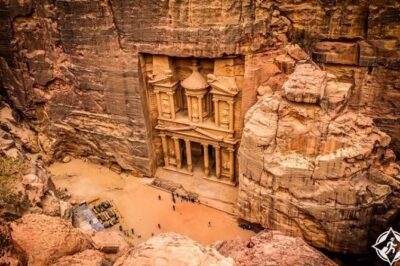
Amman Walking Tour: Hidden Gems, Culture & Street Food
Read our review →Browse the lists this tour appears in