
Reviewed · JERASH & AJLOUN CASTLE TOURS
Trip to Jerash, Ajloun and Umm Qais
Jerash gives you the day’s biggest historical hit: a broad Roman city where an oval plaza, theaters, temples, fountains, and long colonnaded streets still make sense on the ground. Ajloun Castle adds a compact medieval fortress and hilltop views, while Um Qais closes the day with Roman ruins and wide views toward the Golan Heights and Sea of Galilee.
I like the private format, especially for families or small groups of up to four. I also like the flexible driving style reported by customers, with drivers such as Bassam, Bassem, Aneese, and Haroun praised for being punctual, friendly, and willing to adjust the day. The catch is important: your driver is not the site guide, and entrance fees are extra.
Key points
- Jerash gets the most time: Plan on about five hours among the Roman streets, theaters, temples, churches, and museum.
- Ajloun adds a different age of Jordanian history: Its 12th-century castle shifts the focus from Roman civic life to Crusader-era defense.
- Um Qais is the scenic finale: Gadara combines ruins, black basalt buildings, and views toward the Golan Heights and Sea of Galilee.
- The vehicle has free WiFi: That is useful during a long day of driving between northern Jordan’s sites.
- You have a private car, not a private historian: Ask for a guide at each entrance if you want detailed interpretation.
- The price works best for four people: At $230 per group, the cost is about $57.50 each before admissions when four people share.
A long northern Jordan day from Amman

This is an ambitious outing, but it makes good use of a full day. The advertised duration is roughly eight to twelve hours, with an 8:00 am start. The wide range matters. Driving time, the pace of your group, time spent at Jerash, and the need to cover three separate sites can all push the day toward the longer end.
The route also gives you a useful sweep of northern Jordan. You begin with Roman urban life at Jerash, move to a strategic Islamic fortress at Ajloun, then finish at ancient Gadara, now called Um Qais. Those places do not feel interchangeable, which is the main reason this trip is worth considering.
A private car gives you more control than a fixed group bus. You can ask for a slower morning at Jerash, shorten a stop if the heat becomes tiring, or adjust the order when practical. One customer managed Jerash and Um Qais after a late start, while another reached only Jerash and Um Qais after running short of time. That is a useful warning: the full three-stop plan works best when you leave Amman promptly.
The vehicle includes free WiFi, and the driving service has been praised for clean cars, clear communication, and help with timing. Communication by WhatsApp has also been useful for people arranging transport in Jordan. Still, the quality of the day depends partly on who is driving and how clearly you explain what you want from the stops.
Other trips into the north from Amman:
- Full-Day Tour: Umm Qais, Jerash, and Ajloun from Amman
★ 5.0 · 162 reviews - Jerash, Ajloun, Umm Qais Day Trip
★ 5.0 · 99 reviews - From Amman: Private Jerash, Ajloun Castle, and Umm Qais Tour
★ 4.9 · 82 reviews
Jerash at five hours: the main event
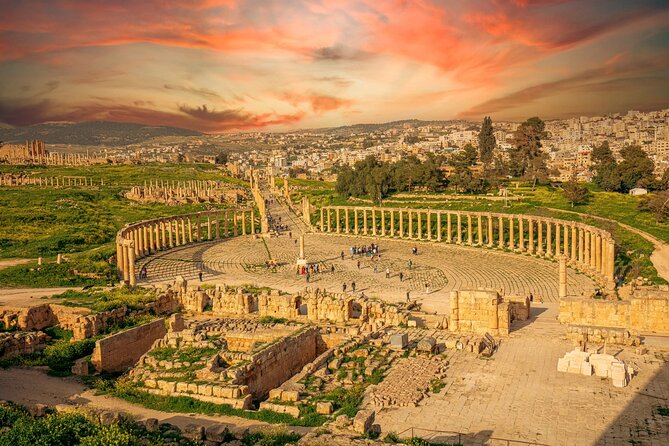
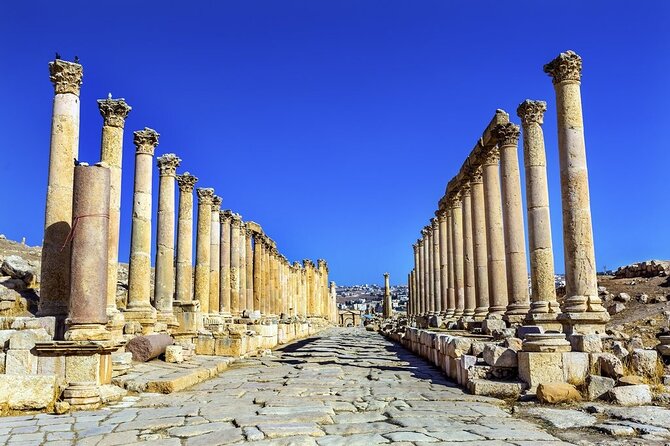
Jerash deserves the longest visit. Five hours is generous enough to walk through the principal ruins without treating the place like a quick photo stop, though you will want comfortable shoes and water. The site is spread out, and its scale becomes clearer as you move from one monumental space to the next.
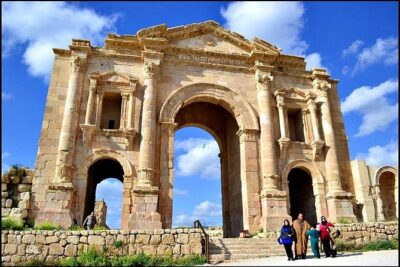
Your first major landmark is Hadrian’s Arch, built to mark the emperor’s visit. It creates a dramatic entrance, but do not stop there for too long. The heart of Jerash lies farther inside, where the Oval Plaza opens into one of the site’s most memorable views.
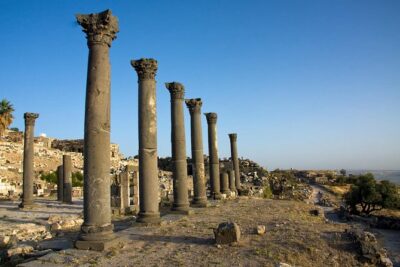
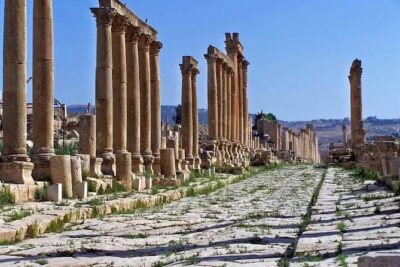
The Oval Plaza is unusually broad and graceful. Its curved shape, surrounding columns, and connection to the main street help you picture how Roman public spaces were designed for movement, ceremony, and display. From here, the colonnaded street leads your eye through the city. The rows of columns are not just decorative remnants. They give Jerash its sense of direction.
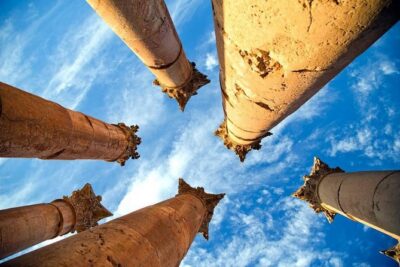
The Temple of Artemis is another essential stop. Artemis was the city’s patron deity, and the surviving columns show the scale of the original sanctuary. The Temple of Zeus and the South Theatre add more evidence of Jerash as a major Roman center rather than a small provincial outpost.
The South Theatre is especially useful if you want to understand the city as a place for public life. Its seating and stage area remain legible, and the setting makes it easy to imagine performances and civic gatherings. The North Theatre gives you a second point of comparison. Seeing both helps you notice how the city served different public needs.
Look for the Nymphaeum, the elaborate public fountain. Water was a sign of urban prosperity, and the decorative remains make this stop more than a quick architectural detail. Along the way, Byzantine churches show how the city changed after the Roman period. Their mosaics and plans bring a later Christian chapter into a site that is often described too simply as Roman.
The Archaeological Museum is worth keeping in your plan, particularly if the sun is strong. It provides objects and context that can be hard to grasp from columns alone. The exact length of your museum visit will depend on your interests, but skipping it entirely can leave the ruins feeling like a collection of impressive stones rather than a functioning city.
There is one practical limitation. A driver who drops you at the entrance may not explain the history as you walk. You can request a guide at the entrance if you want help identifying buildings and understanding how the city developed. If you prefer to explore independently, download or prepare background notes before setting out, since the transport service itself does not promise on-site guiding.
Ajloun Castle and the change from Rome to the Crusades
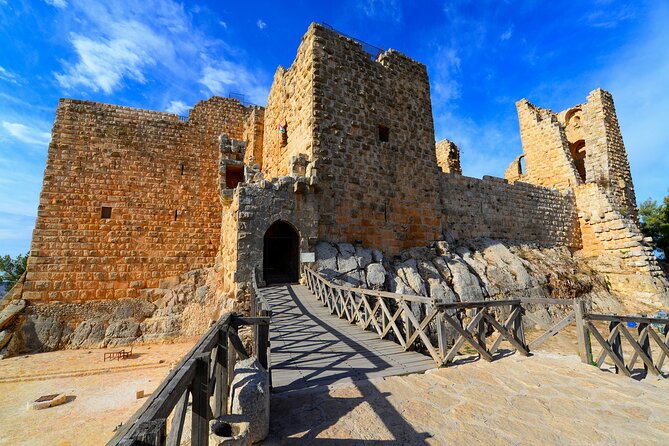
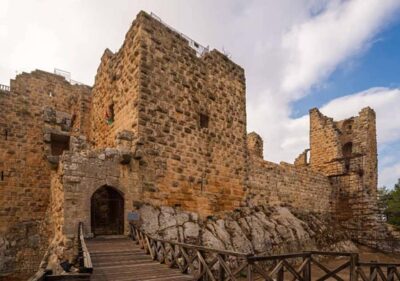
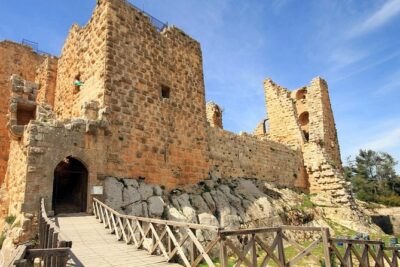
Ajloun Castle receives about two hours, enough for a purposeful visit without turning the whole day into a fortress tour. The castle, also called Qala’at ar-Rabad, dates to the 12th century and reflects a very different period from Jerash.
Here, thick walls, towers, passages, and elevated positions matter more than grand plazas. The fortress was built for defense during the era of the Crusades, and its hilltop location gives you a practical sense of why the site mattered. You can look across the surrounding countryside and understand the value of controlling a high point.
Ajloun is not as sprawling as Jerash, which makes it easier to explore within a shorter stop. It also gives your day a welcome change of pace. After several hours of Roman columns and theaters, you move into tighter rooms and defensive architecture.
The drawback is that two hours may feel rushed if you want to inspect every part of the castle slowly. You also need to keep an eye on the clock. One flexible outing reached Jerash and Um Qais but ran out of time for Ajloun, showing how quickly this three-site route can become too full.
If Ajloun matters most to you, say so before leaving Amman. A private tour gives you a better chance of protecting that stop than a large scheduled group, but the overall 8 to 12-hour window still has limits.
Um Qais in one hour: ruins with a wide view
Um Qais, ancient Gadara, is scheduled for about one hour. That is enough to see the principal sights and enjoy the viewpoint, but it is the briefest stop of the day. If you want a slow museum visit, detailed photography, and time among the ruins, you may find the stop tight.
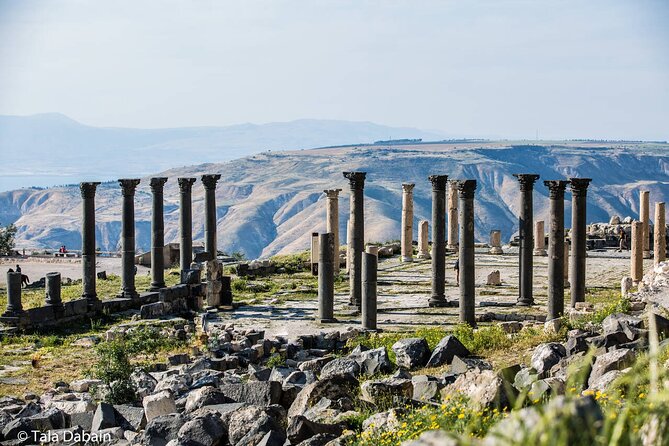
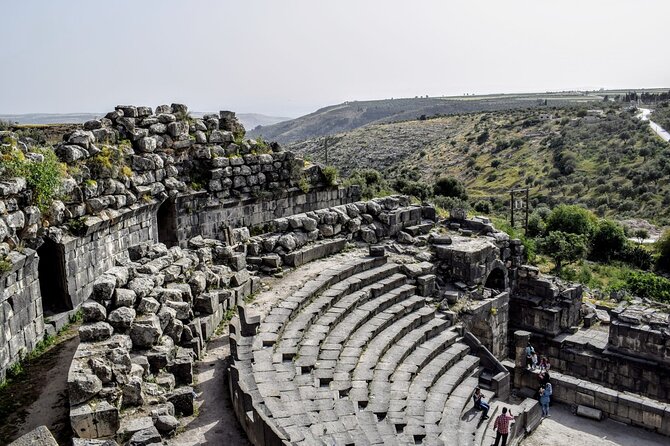
The Roman Theater is one of the central sights. Its dark stone gives it a different character from the lighter masonry at Jerash. The colonnaded street and Byzantine church add variety, while the black basalt structures help you recognize the local building style.
The site also includes Ottoman-era buildings, which add a later layer to the ancient city. This mixture of Roman, Byzantine, and Ottoman remains is one reason Um Qais feels different from Jerash. You are not seeing one period frozen in place. You are moving through several periods of settlement.
Do not rush past the viewpoint. From Um Qais, you can look toward the Golan Heights and the Sea of Galilee. The view is a major part of the stop, not an optional extra. On a clear day, the combination of ruins and distant water gives Um Qais its strongest sense of place.
The surrounding agrarian setting also matters. It shows that Gadara was connected to productive land rather than isolated from daily life. You may find this stop especially rewarding if you enjoy combining archaeology with open views and rural surroundings.
The Archaeological Museum can help tie the site together, but with only an hour, you will need to choose. I would prioritize the viewpoint, theater, main street, and church before spending too long indoors.
Other Roman and Crusader sites from Amman:
- Private Tour of Ajlun and Jerash
★ 5.0 · 130 reviews - Half Day Tour To Jerash From Amman.
★ 4.9 · 90 reviews - Jerash, Ajloun, and Umm Quais Full-Day Tour
★ 5.0 · 78 reviews - From Amman: Private Full Day Tour Jerash Ajloun & Um Qais
★ 5.0 · 77 reviews
What the $230 private price really buys
The listed price is $230 per group of up to four people. For four, that works out to $57.50 each before entrance fees. For two people, it becomes $115 each, and a solo visitor pays the full group rate, so the value changes sharply with group size.
You are paying for private transport and flexibility rather than a fully guided archaeological tour. Pickup is offered, and the vehicle includes WiFi. Those details matter on a day with long road sections and three separate stops.
The price does not include entrance fees. You pay those directly at the sites, so budget for that separately. A guide is also not automatically included at the ruins. You can ask for one at the entrance if you want detailed explanations.
For a group of four, this can be a sensible way to see northern Jordan without arranging a rental car or managing the full route yourself. For one person, the cost is harder to justify unless private transport and convenience are more important than saving money.
The strongest value comes from the combination of private scheduling and a driver who knows the route. Customers have specifically praised punctuality, clean cars, friendly service, and flexibility. Bassam or Bassem received warm comments for a relaxed family outing, while Aneese and Haroun were also described as professional and helpful in wider Jordan transport arrangements.
Keep expectations clear. A friendly driver can make the road time much better, but that does not automatically turn the excursion into a guided history tour. If interpretation is central to your plans, arrange a guide at the sites.
How to make the day work better
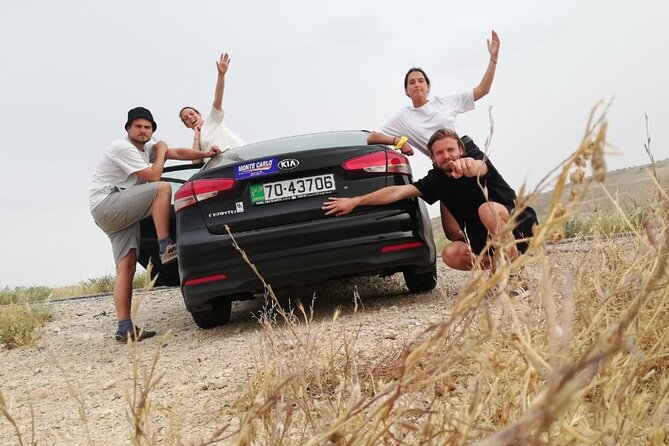
Start at 8:00 am. That is the simplest way to protect all three stops, especially if you want the full five hours at Jerash. A late departure may still allow Jerash and Um Qais, but Ajloun is the stop most likely to disappear.
Tell the driver your priorities before leaving. You might want a museum-heavy day, extra time at the viewpoints, or a faster route through the theaters. Since this is a private activity, the conversation matters.
Use the car’s WiFi for maps, messages, and quick research between sites. It can also help you prepare a short explanation of Roman Jerash or Gadara if you decide not to hire local guides.
Bring water, sun protection, and shoes suitable for uneven ancient paving. The information provided does not promise specific accessibility arrangements, so anyone with mobility concerns should ask the operator before booking.
The route requires good weather. If poor conditions cancel the trip, you are offered another date or a full refund. Normal cancellation is free when made at least 24 hours before the start time, but changes or cancellations inside that window are not accepted.
Who should book this northern Jordan circuit?
I would choose this trip if you are based in Amman and want to cover three major northern sites in one private day. It suits couples, families, and small groups who value a car, pickup, and the ability to adjust the pace.
It is particularly good for people who enjoy seeing several periods of history in one outing. Jerash gives you monumental Roman remains, Ajloun provides medieval military architecture, and Um Qais adds Byzantine and Ottoman layers plus a fine viewpoint.
I would hesitate if you want an in-depth guided experience at every site. The driver is not the guide, and Um Qais receives only about an hour. You may prefer to split the locations across separate days if you want slow museum visits or extensive photography.
Should you book this trip?
Book it if you have one full day, a group of up to four, and a clear interest in Jordan’s northern ruins. The $230 group rate becomes attractive when shared, and private transport removes the strain of arranging a long route yourself.
Before paying, confirm pickup details, ask which driver will accompany you, and decide if you want local guides at the entrances. Leave early, protect your time at Jerash, and treat Um Qais as more than a final photo stop. If you do that, this is a practical and varied introduction to three very different corners of Jordan.
FAQ
How long does the trip take?
The experience lasts approximately 8 to 12 hours, starting at 8:00 am. The total time depends on the route, driving conditions, and how long you spend at each site.
What sites are included?
The trip visits Jerash ruins, Ajloun Castle, and Um Qais, also known as ancient Gadara. The listed sights include theaters, temples, churches, colonnaded streets, museums, Ottoman-era buildings, and a viewpoint.
Are entrance fees included?
No. Entrance fees are not included and must be paid directly at each site.
Is a guide included?
No. The driver is not the guide at the locations you visit. If you want a guide, you can ask for one at the entrance.
How many people can join the private tour?
The price covers one private group of up to four people. Only your group participates in the activity.
What is included in the vehicle?
Pickup is offered, and the vehicle includes free WiFi or internet access. The $230 price does not include entrance fees.
What happens if the weather is poor?
The experience requires good weather. If it is canceled because of poor conditions, you can choose another date or receive a full refund.
Just added in Amman
- 2-Day Private Tour in Jordan – Deluxe Tent★ 5.0 · 9 reviews
- Queen Alia Airport Transfers From / To Amman, Petra, Dead Sea.★ 5.0 · 3 reviews
- FROM AMMAN | Petra & Wadi Rum in one day | The Jordanian Mappers★ 5.0 · 12 reviews
- From Amman :Private full day tour to Jerash ,Ajoune and Um Qais★ 5.0 · 12 reviews
- From Amman to West ( Madaba, Mt Nebo, baptism site and dead sea)★ 4.0 · 5 reviews
- Dead Sea Half-Day Tour from Amman★ 5.0 · 8 reviews
- airport pick up & transportations Services★ 5.0 · 15 reviews
- NEOM Saudi Arabia Transfer from AMM Airport or Aqaba Airport AQJ★ 5.0 · 3 reviews
Jerash & Ajloun Castle Tours, compared.
Full-Day Tour: Umm Qais, Jerash, and Ajloun from Amman
Read our review →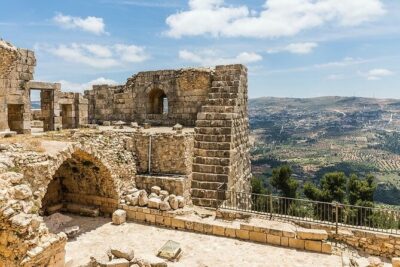
6-Night Best of Jordan Tour from Amman: Jerash, Dead Sea, Petra, and Wadi Rum
Read our review →Browse the lists this tour appears in