
Reviewed · PETRA TOURS
Petra Back-Road Trail and Hike
The best part of this Petra tour is the way it approaches the ancient city from the back. You begin at Little Petra, walk through rugged mountain country, and reach the Monastery before following Petra’s main route toward the Treasury. The big reward is seeing Petra unfold gradually instead of entering through the usual Siq and meeting the Treasury first.
I like two things here. First, the hike gives you wide views toward Wadi Araba and the west bank mountains. Second, the private group size, capped at six, should make it easier to set a sensible pace and ask questions. The drawback is equally clear: this is a long, demanding day of walking, and anyone expecting a light sightseeing outing may find the route too strenuous.
Key points to know before booking
- A back-door approach to Petra: Begin at Little Petra and reach the Monastery by a mountain route.
- The Monastery comes early: You see Petra’s huge Al Dayr monument before the main city sights.
- A full-day hike: Plan on roughly eight to nine hours, with substantial walking and stairs.
- Private group value: The $380 rate covers up to six people, not each person separately.
- A strong sequence of sights: Little Petra, Siq Ghorab, Shamasah, the Monastery, Qasr Al-Bint, tombs, the Treasury, and the Visitor Center all fit into one day.
- Moderate fitness is needed: Rocky paths, mountain walking, and more than 800 steps near the Monastery are part of the day.
Why the back route changes your Petra visit
Most people meet Petra through the narrow Siq leading to the Treasury. This route flips the order. You start near Little Petra, walk across the hills, and arrive at the Monastery from above and behind. Only later do you reach the Colonnaded Street, the Street of Facades, the Treasury, and the Visitor Center.
That change matters. The Monastery is one of Petra’s largest monuments, measuring about 47 meters wide and 48.3 meters high. It was cut into the rock in a style similar to the Treasury, but its scale feels more forceful. Reaching it after a long mountain approach gives the building a proper sense of arrival.
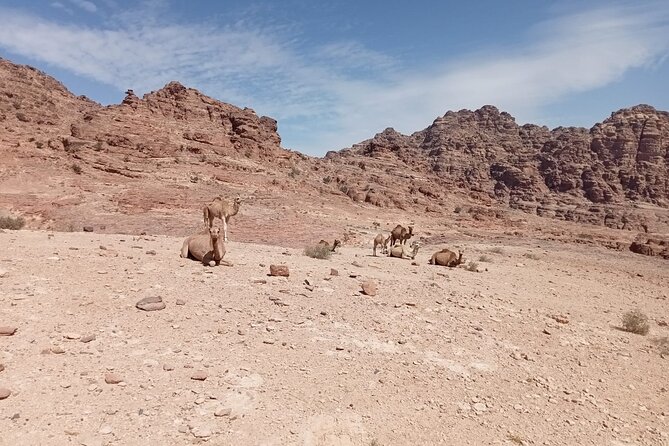
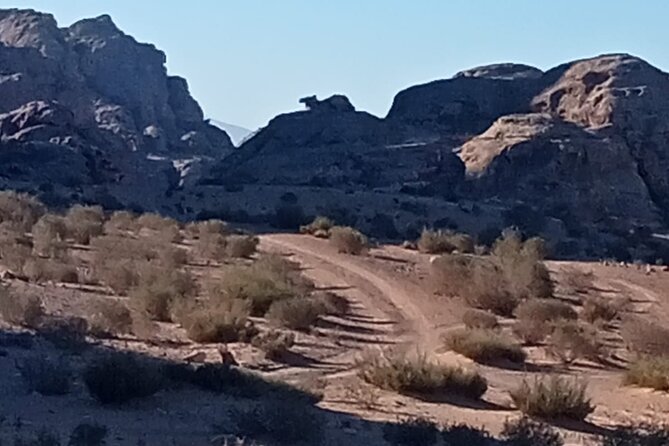
You will not spend the whole day inside the central ruins. Much of the route is outdoors, across mountain paths and through a large canyon called Siq Ghorab. This makes the day feel more like a route through Petra’s wider setting than a standard stop-by-stop tour.
The experience begins at 9 a.m. Pickup is available, or you can meet at Little Petra. The stated duration is eight to nine hours, so protect most of your day for it. The group limit is six people, which is useful on a hike where the pace and number of pauses matter.
Other ways to see the rose-red city from Petra:
- Petra & Wadi Rum: Full Day Private Tour with Hotel Pickup
★ 4.9 · 310 reviews - Lasting memories in Petra & Jordan
★ 5.0 · 270 reviews - 3-hour Private Guided Tour In Petra with hotel pick up.
★ 5.0 · 152 reviews
Little Petra and the old settlement at Beidha
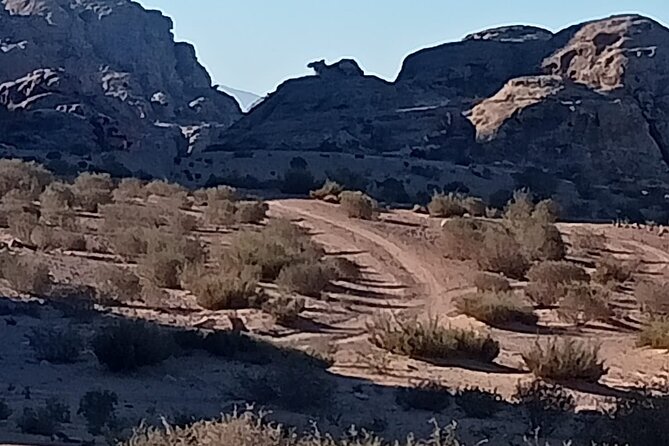
The first stop is Al-Beidha, better known as Little Petra or Siq al-Barid. The name refers to the cool canyon, and the setting is smaller and tighter than Petra’s famous Siq. The passage sometimes widens into small areas lined with rock-cut buildings and old temples.
You can see painted houses and carved spaces along the walls. These are not just a quick photo stop. They give you an early look at the Nabataean habit of shaping homes, religious spaces, and public places directly into sandstone.
The tour also includes the Neolithic settlement of Beidha. This site is associated with one of the oldest settlements in Jordan, where hunters and gatherers lived seasonally. That adds a much earlier layer to the day, before the Nabataeans and later Roman and Byzantine periods.
The scheduled time here is about two and a half hours, including the Little Petra visit and the Beidha area. That is a generous opening section, but it also means you should not rush through it. If you want only Petra’s famous monuments, the early archaeological material may feel slow. If you like seeing how a place developed over thousands of years, it is a worthwhile start.
Siq Ghorab, Shamasah, and the mountain route
From Little Petra, you take the route toward greater Petra by foot. The path passes through dramatic mountain scenery and reaches an old village with remains of earlier habitation. The route then enters Shamasah through Siq Ghorab, a large canyon.
This is the part that gives the tour its character. You are not simply walking between paved viewpoints. You are moving through the same broad mountain country that helped protect Petra and shape how people entered it.
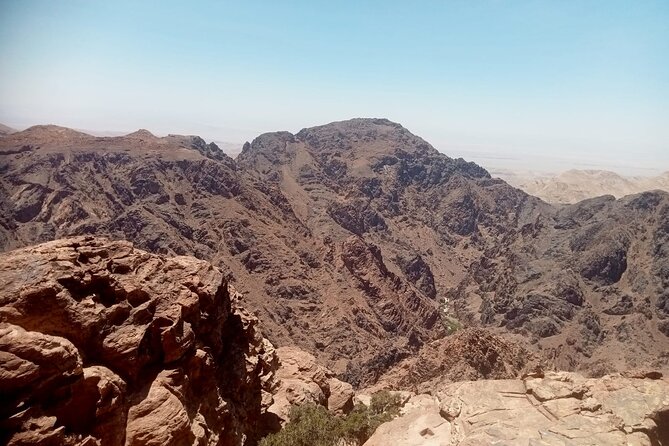
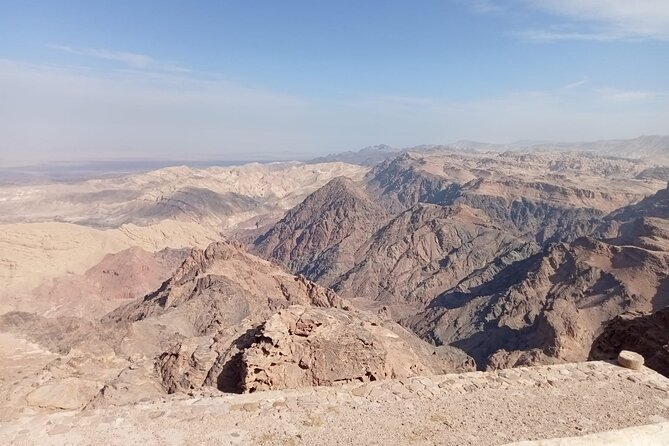
The route also leads to a panoramic view toward Wadi Araba and the mountains of the west bank. The view is one of the day’s best reasons to choose this approach. In the main archaeological center, the rock walls and monuments demand your attention. Here, the view opens outward and shows how remote Petra can feel.
The exact walking pace is not stated, so ask about the route and current conditions before setting out. The tour calls for a moderate fitness level, and that should be taken seriously. Wear sturdy walking shoes, carry water, and expect uneven ground rather than a simple stroll.
The Monastery after more than 800 steps
The Monastery, or Al Dayr, is the main prize on the back route. The approach includes an ancient rock-cut path with more than 800 steps from the Basin Restaurant area. Those steps are the clearest physical challenge of the day.
The building itself is enormous, about 50 meters wide and 45 meters high by the commonly cited measurements given for the tour. It was built as a Nabataean tomb in the third century BCE and uses a design related to the Treasury, but on a larger scale.
The name Monastery comes from the crosses carved into the interior walls, suggesting later Byzantine use as a church. That later reuse is one of the useful details to look for. Petra did not stop changing when Nabataean power faded. Later communities adapted its buildings to their own needs.
You receive about two hours here. That gives you time to look closely at the facade, recover from the climb, and take in the views around the monument. The best photographs often need a little distance because of the building’s size.
This is also where the route may separate strong walkers from everyone else. The steps are not a minor detail. If knee problems, heat, or long climbs are concerns, ask the operator whether a slower pace or an adjusted plan is possible.
More walking country around Petra:
- Petra to Wadi Rum Trek – 6 Days
★ 5.0 · 11 reviews - Dana to Petra Trek + Wadi Rum & the Dead Sea – 9 Days
★ 5.0 · 165 reviews - Full Day Desert Tour, Jeep & Hiking
★ 5.0 · 98 reviews - From Amman: Wadi Mujib Siq Trail Private Hiking Tour
★ 4.9 · 36 reviews
Qasr Al-Bint and the Colonnaded Street
After the Monastery, the route turns toward Petra’s main old city. You pass Qasr Al-Bint and continue along the Colonnaded Street, an ancient Nabataean construction later renovated during the Roman period.
The street was restored to about six meters wide. Excavations suggest that buildings one or two stories high once lined it, though many now lie in ruins. At its end is the triple gate opening toward the Qasr Al-Bint shrine.
The Colonnaded Street helps you picture Petra as a functioning city, not just a group of impressive tomb facades. People moved through it, visited religious buildings, and used public spaces. After the remote mountain trail, this section brings you back into the center of urban Petra.
The scheduled visit is about one hour. That is enough to see the main features, though you will be covering a lot of ground by this point. Pay attention to your energy here. The day is not finished once you leave the Monastery.
Street of Facades and the Royal Tombs

The Street of Facades is a compact row of tombs cut into the rock. It is easy to reach and includes several chambers worth examining. Tomb 67 is notable because its upper level includes a funeral chamber.
This area is useful because you can get close to the facades and see how varied the tombs are. The carving is not limited to one grand building. It continues along the rock face in smaller and more practical forms.
The scheduled time is 30 minutes. That may be enough for a focused visit, but it is short if you want to inspect every chamber. Your guide’s explanations will matter here, especially if you want more than a quick look at the carved fronts.
The Royal Tombs rise above the center of Petra on the western slope of Jabal Al-Khubtha. This group includes the Urn Tomb, Silk Tomb, Palace Tomb, Corinthian Tomb, and Tomb of Sesto Fiorentino.
To reach the Royal Tombs, you climb stairs toward the Urn Tomb. The Urn Tomb later served as a place of worship during the Byzantine period. The Silk Tomb gets its name from the strong shades in its sandstone facade.
This stop is listed at about one hour, but admission is not included in the stated itinerary details for the Royal Tombs. Confirm what your booking covers before setting out, especially if you want to enter or access areas that require a separate ticket.
The Treasury as the final major reveal
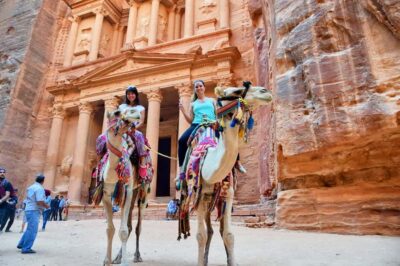
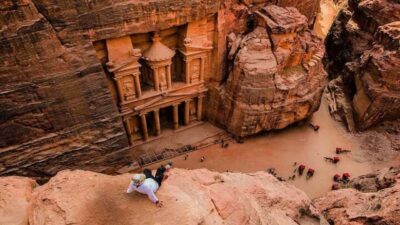
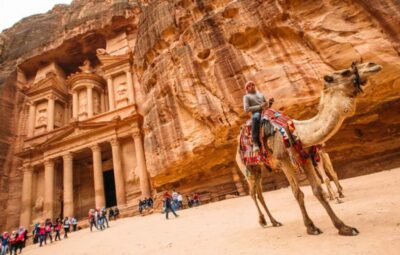
The Treasury, or Al Khazna, arrives late in the day. That is a smart piece of route design. Instead of using the Treasury as the opening surprise, the walk builds toward it after you have already seen the Monastery, the city streets, and several tomb groups.
The facade is about 40 meters high and includes Corinthian capitals, friezes, figures, and two levels of carved decoration. Its original purpose remains uncertain, though it is generally understood as a royal memorial rather than a storehouse of treasure. The urn at the top gave rise to the local story about a pharaoh’s riches.
The Treasury measures about 25.3 meters wide and 39.1 meters high according to the tour information. Its three interior chambers are part of the design, but access to the inside is not included in the stated admission details. Ask your guide what can be entered on the day.
You have about an hour and a half here. That is ample time for the main view and the surrounding area, but remember that you may be tired after the back route. The Treasury is most enjoyable when you can stop, look up at the carving, and understand how the facade fits into the larger rock wall.
The Nymphaeum and Byzantine Church
The final sights include the Nymphaeum and Byzantine Church. The Nymphaeum was a public fountain along the Colonnaded Street. Only the foundations remain, with a tree now providing shade.
It takes about ten minutes to see, so do not expect a complete structure. Its value is in showing that Petra had public water features and civic spaces, not only tombs.
The Byzantine Church was not discovered until the 1990s. Its remains date from the sixth or eighth century, according to the information provided for the tour. Materials from Nabataean and Roman buildings were used in its windows, doors, and reliefs.
You also have about ten minutes here. The stop is brief, but it adds another period to the day. By this point, you have seen evidence of Neolithic settlement, Nabataean construction, Roman changes, and Byzantine reuse.
The route ends at the Petra Visitor Center. That endpoint is practical if you are continuing on from Petra or arranging your own onward transport.
What the $380 group price really means
The cost is $380 per group of up to six people. For six people, that works out to about $63 per person. For two people, it is $190 each, so the value depends heavily on group size.
The price makes the most sense for a full group that wants a private route and a guide for a full day. You are paying for a long walking itinerary, pickup availability, and a route that connects Little Petra with the main archaeological center.
It is less attractive for a solo visitor or couple comparing it with a standard group tour. The advantage is not simply transport. It is the back-route planning and the ability to move as one small group.
One point deserves attention: the tour information does not provide a guide’s name or promise a particular level of historical commentary. If detailed archaeological explanation is your top priority, ask before booking how much interpretation is included. The route itself is strong, but the quality of the day will depend partly on the guide’s explanations and pacing.
Who should book this Petra hike
I would choose this for an active visitor who wants Petra to feel like a route through the mountains, not a short walk to the Treasury and back. It is especially suitable for a group of four to six people, where the fixed price becomes easier to justify.
You should be comfortable with:
- Eight to nine hours on the move
- Uneven mountain paths
- More than 800 steps near the Monastery
- A moderate level of physical exertion
- A full day with several archaeological stops
This is not the best choice if you have limited walking ability, want only the central monuments, or prefer a slow tour with long indoor stops. The itinerary is ambitious. It covers a great deal of Petra in one day.
The tour is offered with mobile ticketing, pickup, and a 9 a.m. start. Service animals are allowed, and the meeting area is near public transportation. The experience requires good weather. Cancellation is free up to 24 hours before the start, while a weather cancellation offers a different date or full refund.
Should you book the Petra Back-Road Trail?
Book it if you want the Monastery first, Treasury later and like the idea of reaching Petra through Little Petra, Siq Ghorab, Shamasah, and the mountain trails. The views and route are the strongest reasons to choose it.
Think twice if you need a gentle day or want guaranteed, detailed historical teaching. The hike is long, the stair climb is real, and the guide’s name and commentary level are not specified. For an active group of up to six, though, the $380 price can be fair for a private full-day route that covers both Petra’s famous monuments and its quieter approach.
FAQ
Where does the tour begin?
You can be picked up, or you can meet the group at Little Petra. The scheduled start time is 9 a.m.
How long does the experience last?
The tour lasts approximately eight to nine hours.
How many people can join the group?
The maximum group size is six people.
What is included in the route?
The route includes Little Petra, Beidha, Siq Ghorab, Shamasah, the Monastery, Qasr Al-Bint, the Colonnaded Street, the Street of Facades, the Royal Tombs, the Treasury, the Nymphaeum, the Byzantine Church, and the Petra Visitor Center.
How difficult is the hike?
A moderate level of physical fitness is required. The route includes mountain walking, uneven paths, and more than 800 steps near the Monastery.
Is the Petra entrance ticket included?
The itinerary specifically marks admission as included for Little Petra, the Monastery, the Colonnaded Street, the Street of Facades, the Nymphaeum, and the Byzantine Church. It marks the Royal Tombs and Treasury as not included, so confirm the full ticket arrangement before booking.
Is pickup available?
Yes. Pickup is offered, and you may also meet at Little Petra.
Is the tour available with a mobile ticket?
Yes, mobile ticketing is offered.
What happens if the weather is poor?
The experience requires good weather. If it is canceled because of weather, you can choose another date or receive a full refund. You can cancel for a full refund up to 24 hours before the start time.
Just added in Petra
- From Petra to Wadi Rum, then back to Amman or the airport.★ 5.0 · 16 reviews
- Cooking outside in little Petra between the Mountains.★ 5.0 · 6 reviews
- Private Transfer From Petra to Amman or Airport With Optional★ 5.0 · 4 reviews
- Wadi Rum Day Tour from Petra ending in Aqaba★ 5.0 · 3 reviews
- Petra to Wadi Rum Trek – 6 Days★ 5.0 · 11 reviews
- Petra Highlight Tour with Private Guide Sami Nawafleh | 2.5 Hours★ 5.0 · 3 reviews
- Private transfer Petra to/from Wadi Rum★ 5.0 · 3 reviews
- Private Petra Back Entrance Tour with Guide .★ 5.0 · 16 reviews
Petra Tours, compared.


3-Day Private Tour from Amman: Petra, Wadi Rum, Dana, Aqaba, and Dead Sea
Read our review →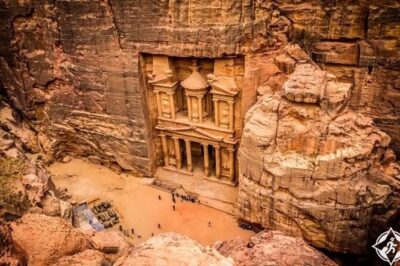
Petra & Wadi Rum: Full Day Private Tour with Hotel Pickup
Read our review →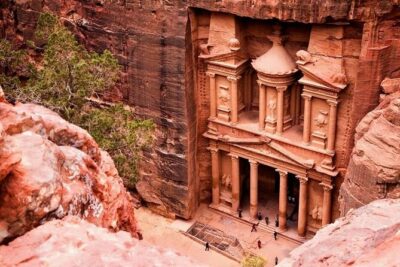
Browse the lists this tour appears in